Ever wonder why that beautiful fiddle leaf fig you bought looks perfectly happy at the store but starts dropping leaves the moment it enters your living room? As someone who has spent two decades studying the cellular secrets of greenery, I can tell you the answer is almost always hiding in plain sight: it’s the light. When we think about indoor plant care, we often treat light like a piece of home decor—something that illuminates our furniture. But for your plants, light isn’t just an aesthetic choice; it is their primary source of survival.
In this guide for indoor plants, we are going to dive deep into the physics and biology of lighting. By the end, you’ll understand how to read your home like a botanist and ensure your indoor plants are getting the energy they need to thrive, not just exist. If you’ve been wondering how to start plant care at home, understanding light is your very first step.
Light Is Food: Understanding Lighting for Indoor Plants
To truly master plant care at home, we have to shift our perspective. We eat sandwiches and salads for energy; plants eat photons. Through the miracle of photosynthesis, plants take invisible substances—light, water, and carbon dioxide—and knock them together to produce physical structures and sugar. This process occurs in specialized organelles called chloroplasts, which are the result of endosymbiosis—essentially, plants formed a long-term symbiotic partnership with photosynthetic bacteria over a billion years ago.
Inside these chloroplasts, there are structures that look like stacks of green hamburgers called thylakoids. When light hits these thylakoids, it triggers a “light reaction” that splits water molecules and generates a proton gradient. This gradient drives a tiny molecular motor called ATP synthase, which produces ATP (adenosine triphosphate), the energy currency of the cell. Without enough light, this motor stops, the plant can’t produce its “meal,” and it begins to consume its own reserves. Light isn’t a preference; it’s a plant’s meal.
Understanding this metabolic reality is essential for any beginner guide for indoor plants. When a plant is in a dark corner, it isn’t just “unhappy”—it is literally starving. This is why we must prioritize the best lighting for indoor plants above almost any other factor in our indoor plant care guide.
Lux Breakdown: Measuring the Light
One of the most common indoor plant care mistakes is assuming that if a room feels “bright” to a human, it is bright enough for a plant. Humans are incredibly good at adapting to darkness; our pupils dilate to let in more light, tricking our brains into thinking a room is well-lit. Plants don’t have pupils. They only care about the actual number of photons hitting their leaves, which we often measure in Lux (lumens per square meter).
If you want to know how much light do indoor plants need, you have to look at the numbers. Based on botanical research, here is a breakdown of what lux for plants actually looks like in a home setting:
| Light Level | Lux Range | Typical Location | Best For |
|---|---|---|---|
| Low Light | 500 – 1,000 | Far North window or 2m+ from a window | Snake Plant, ZZ Plant, Cast Iron Plant |
| Medium Light | 1,000 – 2,500 | East or West window (indirect) | Pothos, Dracaena, Spider Plant |
| High Light | 2,500 – 10,000+ | South window or very close to window | Cacti, Succulents, Jade, Croton |
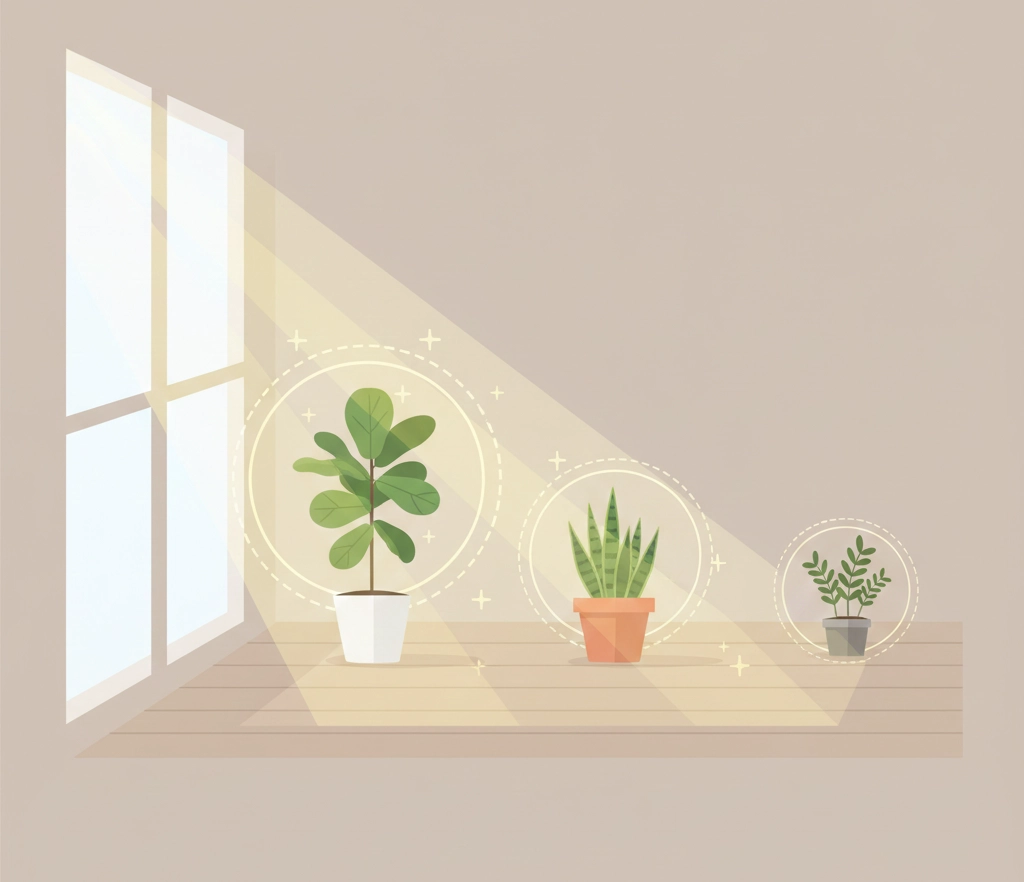
When you’re just getting started, a professional light meter isn’t necessary to get these readings. I recommend downloading a free “Light Meter” app on your smartphone. While not 100% lab-accurate, it will show you that moving a plant just a few feet away from a window can cause a massive drop in the “food” available to it. This is a core part of any indoor plant care guide.
Compass Science: The Power of Window Orientation
To provide the best lighting for indoor plants, you need to understand the quality of light coming through your windows. Every window has a “personality” based on the direction it faces.
South-Facing Windows
These are the “all-day hot sun” zones. They provide intense, direct light that is perfect for desert-dwellers like Cacti, Succulents, and Jade. However, this light can be so intense that it burns the leaves of foliage plants that evolved under forest canopies.
North-Facing Windows
These provide the lowest light but are very stable. There is no direct sun, which makes it the realm of low light houseplants like the Snake Plant (Sansevieria) and ZZ Plant. These plants have high chlorophyll efficiency, allowing them to survive on the “scraps” of light available in these North-facing corners.
East-Facing Windows
These provide “cool sun” in the morning. This gentle light is ideal for “divas” like Prayer plants (Maranta) or Calathea, which need humidity and bright light but can’t handle the scorching heat of the afternoon.
West-Facing Windows
These offer “hot sun” in the afternoon. The light here is harsh and can significantly raise the temperature of the room. It’s a great spot for Hoya, Ficus, or Philodendron that are a bit more heat-tolerant.
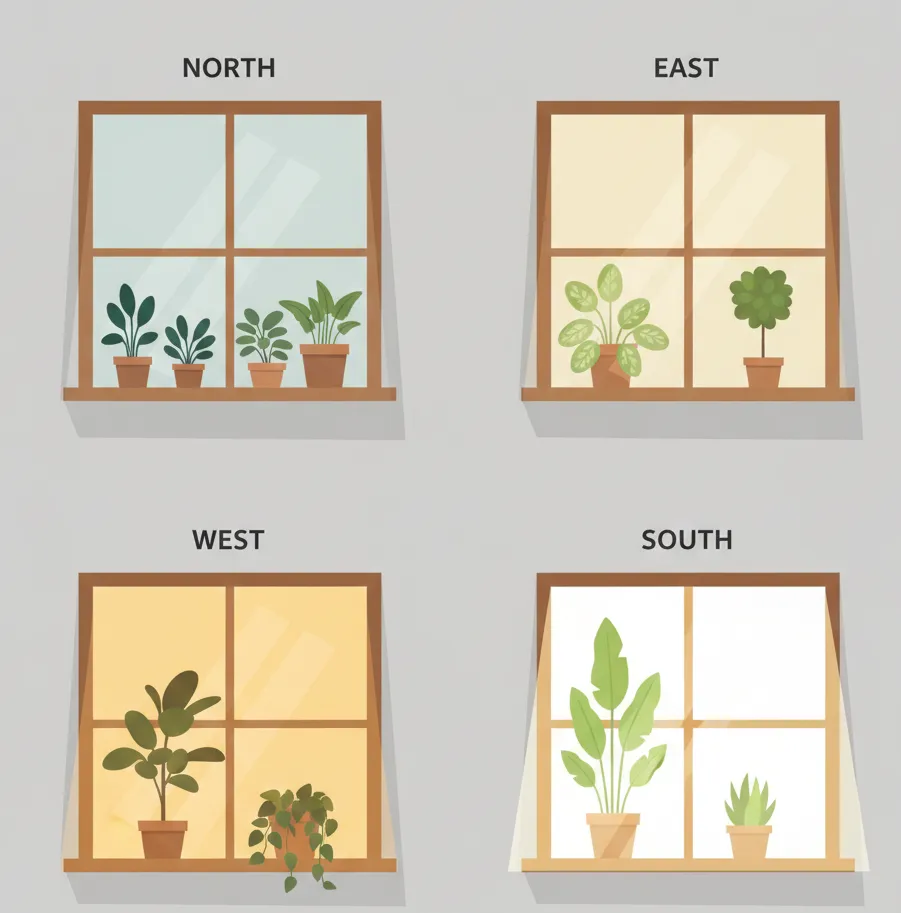
Matching the right species to the right window is the secret to keep your indoor plants alive. Always remember to rotate your plants every couple of weeks so they grow evenly; otherwise, one side will be “full” while the other starves.
Advanced Botanical Concepts for the Modern Home
To understand light, we need to think a bit like a plant. It’s not just about how bright a room feels to us; it’s about how light actually travels through our windows and hits those leaves.
The Inverse Square Law
This is a critical concept for indoor plant care at home. Light intensity decreases exponentially as you move away from the source. In a typical home, moving a plant 2 meters away from a window can result in a ~75% loss of light. To us, the corner looks ‘bright,’ but for the plant, the energy source has practically vanished. If you are growing indoor plants, keep them within 1 meter of a window whenever possible.
Why Is My Plant Growing Crooked?
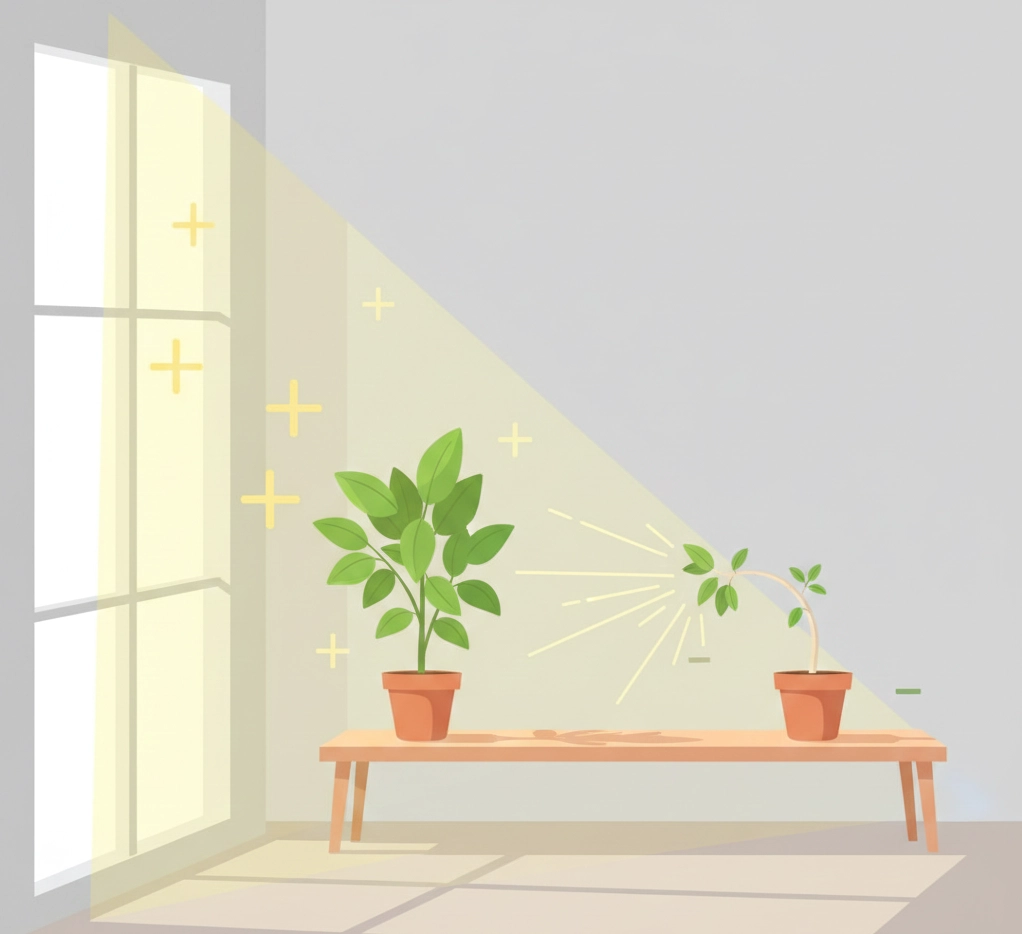
If your plant is leaning desperately toward the window, it is experiencing etiolation. This is a plant’s high-stakes search for energy. When a plant senses low light, its internal clock and hormones (specifically auxin) go into overdrive.
Auxin concentrates on the “dark side” of the stem, causing those cells to lengthen rapidly, while the cells on the light side stay small. The result? A weak, leggy, and crooked plant that is stretching its resources to find a light. If you see this, it’s a clear sign of unhealthy plant growth—your plant is telling you it needs to move closer to the light.
Low-E Glass and UV Filtering
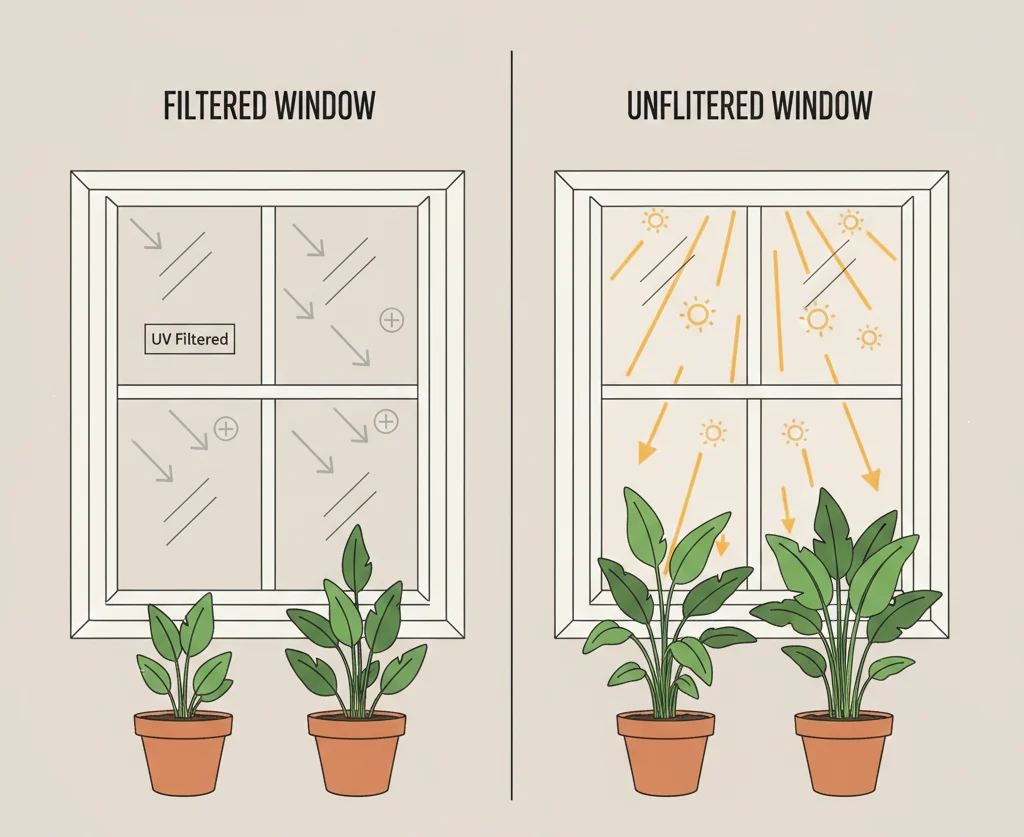
Modern homes often use Low-E (Low Emissivity) glass or UV-filtering windows to keep the house cool. While great for your energy bill, these windows can block up to 15-20% of the photosynthetically active radiation (PAR) that plants need. If your home has these windows, even a “bright” spot might require grow lights for your indoor plants to supplement the natural light, especially during the winter season.
Species Spotlights: Light Lovers and Shady Characters
Let’s look at two popular indoor plants and how their evolution dictates their lighting needs.
Ficus lyrata (Fiddle Leaf Fig): The Drama of Light Shock
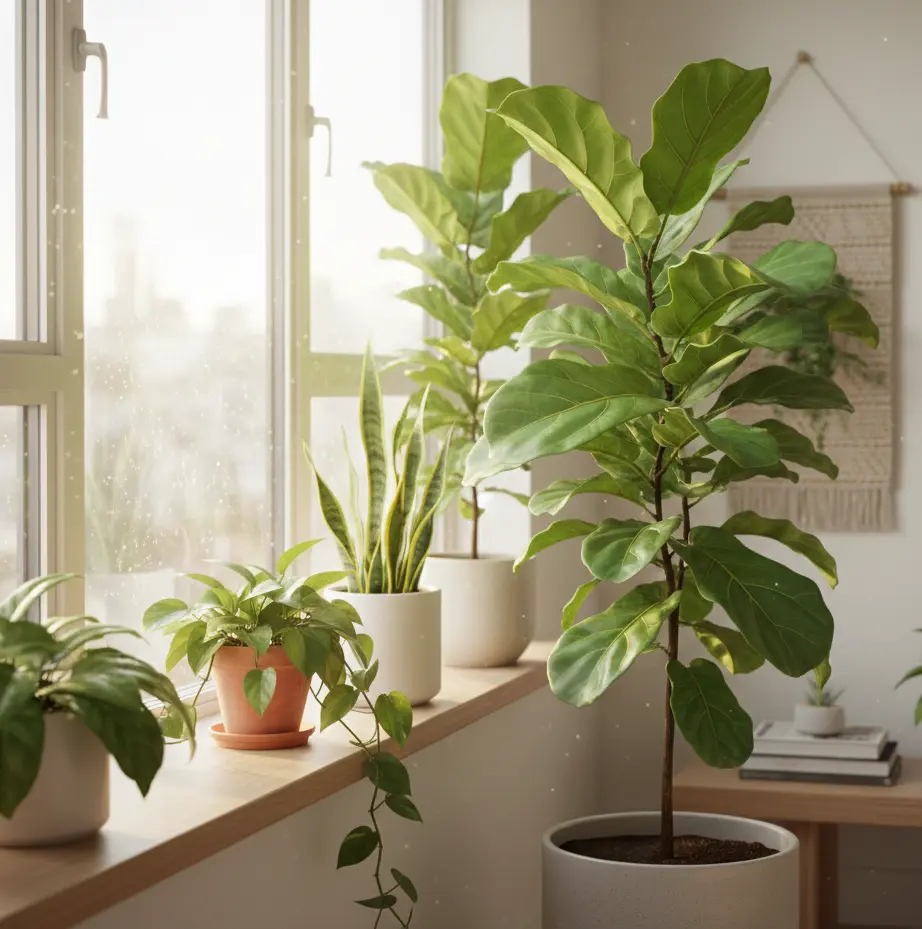
The Fiddle Leaf Fig is notorious for dropping its leaves. In its native tropical environment, it gets plenty of sun. When moved to a new spot, it often undergoes light shock. Because it has a narrow temperature and light range for optimal growth, sudden changes cause the plant to drop leaves as a stress response.
Monstera deliciosa: Why the Holes?
The famous holes, or fenestrations, in Monstera leaves aren’t just for looks. This plant is a “climber” that lives in the understory of rainforests. Botanists believe these fenestrations evolved to allow sunlight (sunflecks) to pass through the large upper leaves and reach the lower leaves. This ensures the entire plant can catch a “meal” of light, even in a crowded jungle. In your home, this means your Monstera is a master at catching bright indirect light.
If your home only has North-facing windows with low lux levels, check out our list of 10 Easiest Houseplants to Keep Alive, where we cover species evolved for dim conditions.
Frequently Asked Questions
What are the 5 basic needs of a plant?
Plants need light (energy), water (solvent/electrons), carbon dioxide (carbon source), minerals (structural building blocks), and oxygen for root respiration.
How often do I water an indoor plant in winter?
During the winter season, days are shorter and light is less intense, which slows down the plant’s metabolism. Because photosynthesis is slower, the plant uses less water. Always check that the top inch of soil is dry before watering.
Do indoor plants remove toxins?
Yes! NASA research originally discovered that the Spider Plant is excellent at cleaning the air. Plants like the Snake Plant and Peace Lily also help improve air quality by filtering out common household pollutants.
Can indoor plants survive without direct sunlight?
Many foliage plants and low light houseplants can survive on bright indirect light or even low-light North windows. However, almost no plant can survive in a room with zero windows unless you use artificial light for indoor plants setup.
What are signs of an unhealthy plant?
Look for yellowing leaves (often overwatering), brown tips (low humidity or fluoride in water), or etiolation (stretching for light).
Building an indoor forest is one of the most rewarding plant care journeys you can take. By matching your plants’ biological “meal” requirements to your home’s natural light, you ensure that your green friends will thrive for years to come. Happy planting🌱